
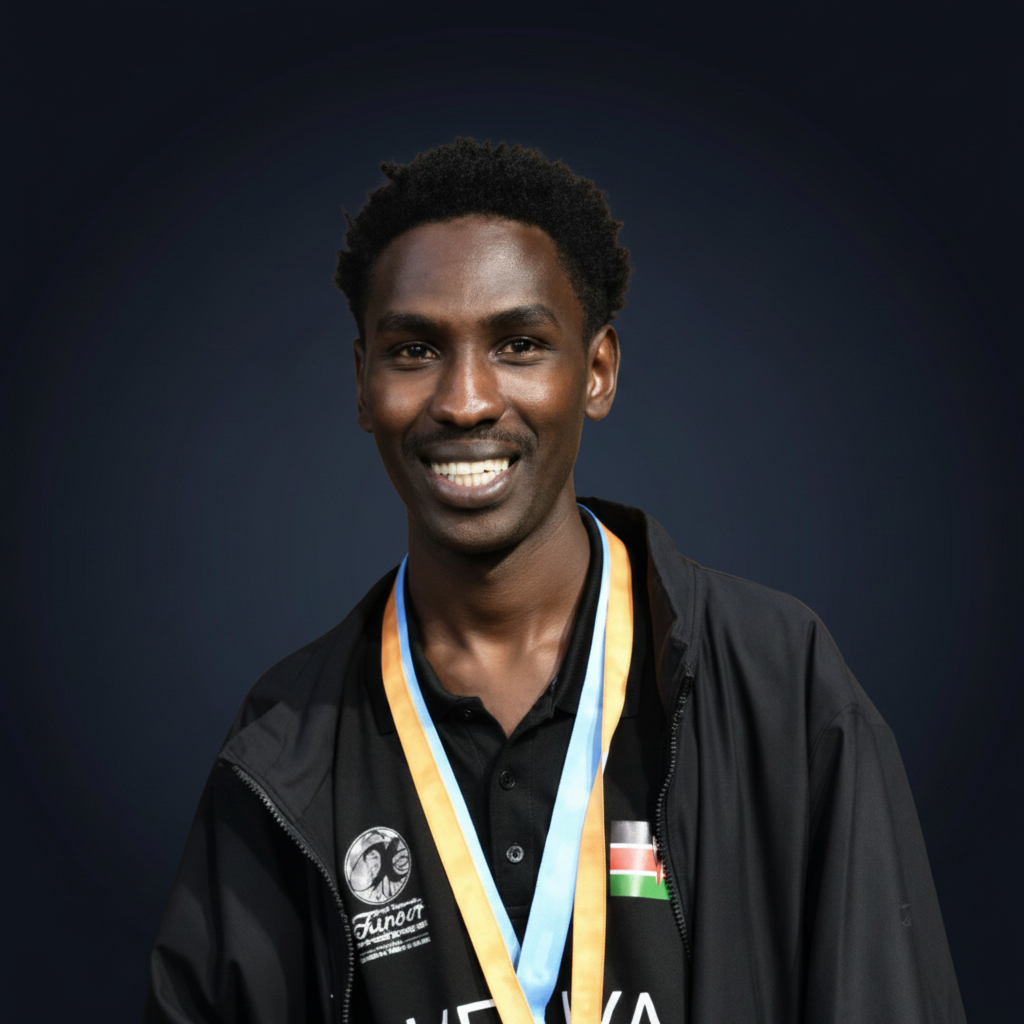
John Tingoi
🇰🇪Kenya
He started the year ranked last in Kenya's national IQC bracket. He ended it third in the world.
John Tingoi finished the 2025 International Quant Championship third out of nearly 80,000 contestants, walking away with $8,000 and a tie for the bronze with a student from Taiwan. He is 22, an Applied Computer Science graduate of Chuka University in rural Kenya, and at the start of the IQC competition cycle he was nowhere near the global lead — the Daily Nation reported he was ranked last among Kenyan participants when stage two began. He clawed his way through three months of alpha submissions on WorldQuant's BRAIN platform to qualify for one of 12 individual finalist slots flown to Singapore in late September 2025.
He builds quant models for a living already — Tingoi works remotely as a WorldQuant Researcher, part of an unusual cluster: Chuka University alone accounts for roughly 800 of WorldQuant's BRAIN consultants in Kenya. His IQC bracket was 9,000 contestants strong before he got out of it. In interviews he has described relying heavily on ChatGPT and OpenAI tools to refine his alpha pipeline, a workflow detail the Kenyan press has carried prominently. His final-year project at Chuka was a blockchain-based healthcare records system — not directly related to markets, but consistent with his pattern of building data infrastructure from first principles.
Outside the championship, Tingoi has been carried by Daily Nation, Citizen Digital, The Star, Safaricom's official newsroom, Kenya Insights, University World News and Tuko — an unusually rich press footprint for a young African quant. The Safaricom feature is titled "The Boy Who Found Refuge in Numbers and Conquered the World," and it's clear the country adopted him as a national story the moment the result came out of Singapore. Of all the named IQC 2025 winners, he is the one with the deepest editorial trail.
Interview
You were ranked last among Kenyan participants when stage two began. What was going through your mind at that point, and what made you keep going?
To be honest, it was discouraging. When you see yourself at the bottom of the rankings, it's easy to question whether you belong there at all. However, I reminded myself that rankings only reflect a moment in time. Instead of focusing on where I ranked, I focused on learning, testing ideas and improving my alphas. What kept me going was the belief that consistent improvement would eventually produce results.
Chuka University is in rural Kenya, not a traditional finance or tech hub. How did you even find out about WorldQuant and the IQC, and what was the reaction around you when you decided to enter?
I first learned about WorldQuant through a friend who had also recently discovered the platform and was trying to learn it himself. Neither of us was particularly experienced at the time, but it sparked my curiosity. Coming from Chuka University, quantitative finance wasn't a common topic of discussion, so much of the learning involved exploring resources independently and learning through experimentation. As I progressed, more people around me became interested in understanding what WorldQuant and quantitative research were all about.
You've said ChatGPT and OpenAI tools were central to your research workflow. Some quants argue that AI is flattening the edge, that if everyone uses the same tools, the advantage disappears. Do you agree? Or does human judgment still win?
I believe AI is a powerful accelerator, but not a replacement for human judgment. Many people can access the same AI tools, but they won't necessarily ask the same questions, interpret results the same way, or pursue the same ideas. AI can help generate possibilities, explain concepts and speed up research, but deciding which ideas are worth testing still requires human reasoning. In quantitative research, creativity and judgment remain extremely important.
Chuka University apparently has around 800 WorldQuant BRAIN consultants. That's a strikingly large number for one campus. Is there a real community there, people helping each other, or is it mostly individual work?
There is definitely a community aspect to it. Beyond Chuka University, we have a large online community where participants from different universities and backgrounds interact. It's similar to a forum where people can ask questions, discuss ideas, share learning resources, and seek help when they encounter challenges. While alpha creation itself is ultimately an individual activity, having access to a supportive community makes the learning process much easier.
The IQC 2025 final was individual, not team-based. You flew to Singapore as one of 12 people in the world. What did that room feel like: the other finalists, the WorldQuant leadership, the pressure?
The experience was surreal. Being surrounded by some of the brightest students and researchers from different parts of the world was both exciting and humbling. There was definitely pressure because everyone in that room had already achieved something significant by reaching the finals. At the same time, there was a strong sense of mutual respect because we all shared a passion for research and problem-solving.
You tied for third with a student from Taiwan and walked away with $8,000. What did that money mean to you practically, and what did the result mean to you beyond the money?
The prize money was meaningful, especially as a student, but the result itself meant much more than the financial reward. It showed me that someone from a relatively small university in Kenya could compete successfully on a global stage. The confidence, exposure, and opportunities that came from the experience have been far more valuable in the long run.
Safaricom ran a piece on you called "The Boy Who Found Refuge in Numbers." That title suggests quant research gave you something beyond a career. What did it actually give you?
Quantitative research gave me a way of thinking. It taught me to approach problems systematically, rely on evidence, and continuously learn. Beyond finance, those lessons apply to almost every aspect of life. It also gave me a global perspective by connecting me with talented people from different countries and backgrounds.
You have mutual connections with Sumit Kumar, the IQC 2025 winner from India, and other finalists from around the world. Did you actually connect with them? What is that global network of young quants actually like: is there a real community, or do you all just compete and disappear?
Yes, I still communicate with some of the finalists and participants. Interestingly, our conversations are not always about WorldQuant or quantitative finance. We often discuss careers, education, opportunities and life after IQC. Naturally, people move in different directions after the competition, but there is definitely a network that remains, and it has been valuable staying connected with talented individuals from around the world.
What do you think separated you from the 8,999 other Kenyan contestants who didn't make Singapore?
I don't think there was a single secret. What helped me was consistency. I spent a lot of time learning, testing ideas, analyzing results and improving my process. Many people focus on finding one perfect alpha, but I focused on continuous improvement. Over time, those small improvements accumulated into meaningful results.
What would you say to a 19-year-old in Nairobi, Kisumu, or Mombasa right now who is curious about quantitative finance but has no idea where to start?
Start with the basics and don't be intimidated by the field. Learn statistics, mathematics, programming and how financial markets work. You don't need to be an expert from day one. Take advantage of free resources online, participate in competitions like IQC, and don't be afraid to ask questions. Your background does not determine your potential. What matters most is your willingness to learn, adapt, and persist.
Sources
- WorldQuant Announces the Winners of the 2025 IQC — BusinessWire
- Citizen Digital — Tingoi finishes third in IQC
- Daily Nation — Meet the Kenyan using ChatGPT
- Chuka University official feature
- Safaricom Newsroom — The Boy Who Found Refuge in Numbers
- The Star — Chuka varsity student in top 3
- University World News feature
- LinkedIn profile