
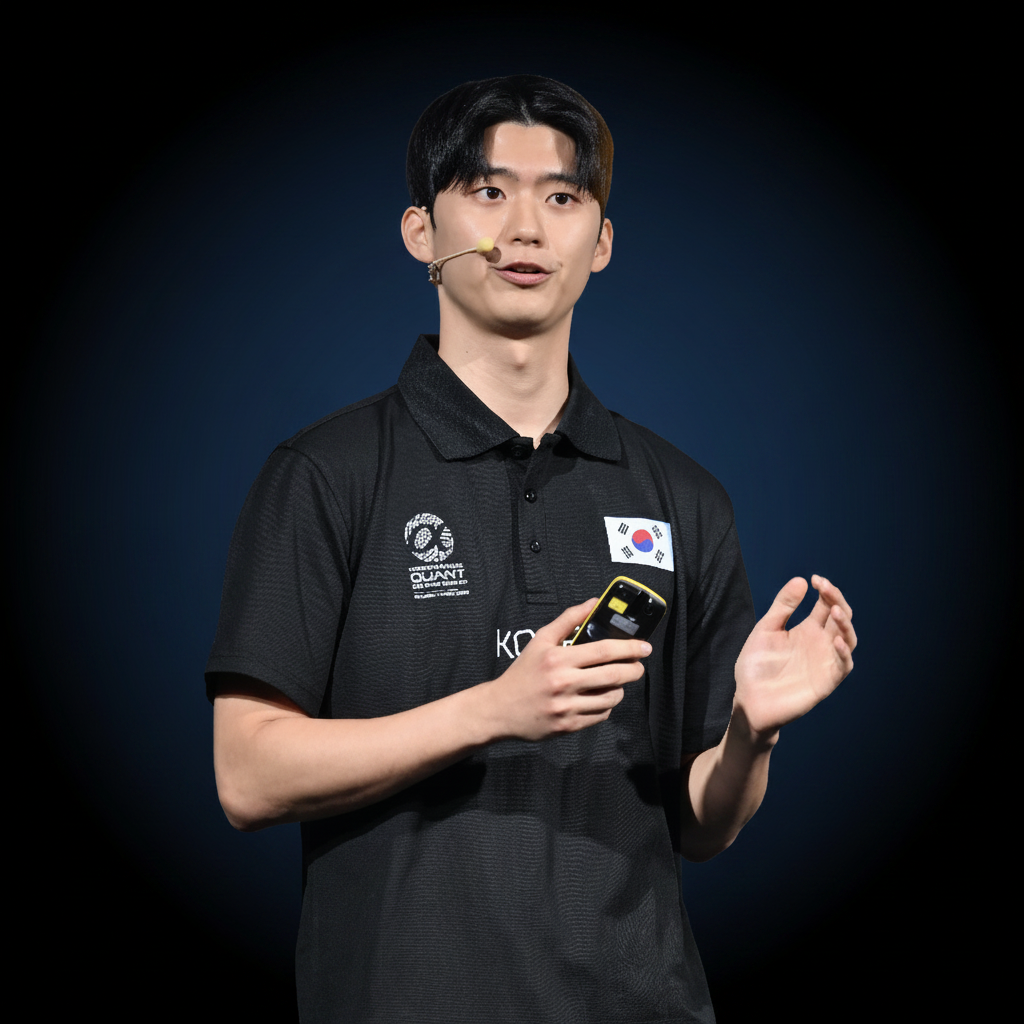
MinKyeom Kim
🇰🇷South Korea· Ulsan
The first Korean to win the IQC — a 25-year-old industrial-engineering undergrad who beat 80,000 contestants from his dorm room in Ulsan.
Out of 80,000 contestants from 11,000 universities, MinKyeom Kim was the one who walked out of the Marina Bay finals with first place. Korea had never won the WorldQuant International Quant Championship before. His prize: $23,000 and a 2026 internship at WorldQuant's headquarters in Old Greenwich, Connecticut. He is double-majoring in Industrial Engineering and Business Administration at UNIST in Ulsan.
He is not a finance or mathematics major. He approached the IQC the way an engineer approaches any problem: define the objective, design a solution, implement it. His workflow had three stages: forming a hypothesis, building a raw signal, then refining it mathematically. What set him apart was the emphasis on hypothesis formation as a safeguard against overfitting — while many competitors chased in-sample Sharpe ratios, Kim built alphas that could hedge one another and hold up out-of-sample.
At the Singapore finals, he defended his research in front of WorldQuant's senior leadership without nerves. He had practiced alone in an empty classroom, imagining the stage right in front of him. By the day of the finals, the nerves never came. His next chapter is the 2026 WorldQuant internship in the U.S.
Interview
You won IQC 2025, beating 80,000 participants from around the world — from a dormitory room in Ulsan. What was that moment like when you first found out?
Ulsan is a quieter city, a bit removed from the bustle of Korea's major urban centers. My journey started from a simple curiosity about finance and quantitative research — winning was never the primary goal. I just focused on studying and building alphas diligently, day by day. When I heard the announcement in Singapore after the final presentation, I was happy, of course — but more than the result itself, what felt meaningful was the growth and learning I experienced throughout the process.
For readers without a quant background: what exactly is an "alpha," and how does one go about building one from scratch?
"Alpha" refers to excess returns — returns above a benchmark, whether that's the broader market or specific factors. The precise meaning varies by context and industry. In the IQC, alpha referred to the quantitative logic itself underlying a long-short equity strategy. Building alpha requires a technical foundation in coding and mathematics, but financial intuition and interpretive skill are just as important. I think the core competency of a quant researcher lies in bridging those two domains and moving fluidly between them.
Can you walk us through your research workflow during the competition — how you generated, tested, and refined signals on the BRAIN platform?
My workflow had three broad stages: forming a hypothesis, building a raw signal, and then developing it through various mathematical techniques. What set my approach apart was the emphasis I placed on the hypothesis-formation stage as a safeguard against overfitting. Many highly skilled CS-oriented participants treated alpha purely as a numerical optimization problem — many saw their in-sample Sharpe ratios collapse by 90% or more out-of-sample. To guard against that, I paid close attention to the financial validity of each hypothesis, considered the macroeconomic interest rate environment, and built alphas that could hedge one another.
You studied industrial engineering, not finance or mathematics. Did that ever feel like a disadvantage — or did it actually help you think differently?
Personally, I felt that industrial engineering was a remarkably well-suited background for quant research. Industrial engineering is fundamentally about defining problems, designing solutions, and implementing them — and quant research is exactly that, just applied to finance. The problem-solving mindset translated naturally: clarifying the objective and constraints, then designing optimized approaches to meet them.
In the Singapore finals, you had to defend your research in front of WorldQuant leadership in a live high-stakes setting. How did you prepare for that?
I simply prepared thoroughly and never lost confidence in my research and alpha portfolio. Having put in genuine effort over six months, my mindset going in was: show them who you've become. That conviction meant I wasn't nervous at all — if anything, I enjoyed it. I practiced alone in an empty classroom, over and over, imagining the Singapore stage right in front of me. By the day of the finals, the nerves never really came.
No Korean had ever won IQC before. Did you feel the weight of that? And beyond the prize money and internship, what does this victory mean to you personally?
I take genuine pride in being the first Korean to win. Honestly, I didn't feel the pressure too heavily in the moment — the whole experience felt new and exciting throughout. The win and the internship opportunity feel like the beginning of my career in the quant industry. As many people know, breaking into this field is extremely difficult. I look forward to learning a great deal and continuing to grow from here.
You've been consistently active — IQC, DBgaps, BRAIN consultant work. What keeps you going? Is it the learning, the competition, or something else?
For me, it's the learning. Philosophically speaking, I think a single individual life, in the grand scheme of things, carries no inherent cosmic weight. Camus asked in The Stranger, "Why not suicide?" — and paradoxically, that question leads me to find meaning in precisely the opposite: the daily act of learning and growing. That might sound rather philosophical — perhaps a bit embarrassing to say out loud — but it's genuinely what drives me.
You're set to join WorldQuant in July 2026. What do you think is the biggest difference between conducting research in a competition setting versus professional practice?
To be more precise, I'll actually be interning at WorldQuant's Yeouido office in Seoul! The biggest difference: in a competition, you're competing against other beginners; in professional practice, you need to create something that adds genuine value to the firm. In IQC, you only need to clear self-correlation thresholds. In industry, you also have to pass production-correlation checks against the entire pool of other researchers' alphas. You're expected to produce research that brings new, meaningful value to the organization.
For a student sitting in their dorm right now, thinking about entering IQC — what's the one piece of advice you wish someone had told you before you started?
I'd borrow Nike's slogan: Just Do It. And alongside that — learn to use AI well, but don't lean on it too heavily. AI won't build a finished product for you from scratch. Where it truly excels is as a learning tool: ask it what you don't understand, use it to organize your thoughts, use it to study. Start moving first. When you hit a wall, use AI to help you get over it. Repeat that process, and you'll look back one day at how far you've come.