
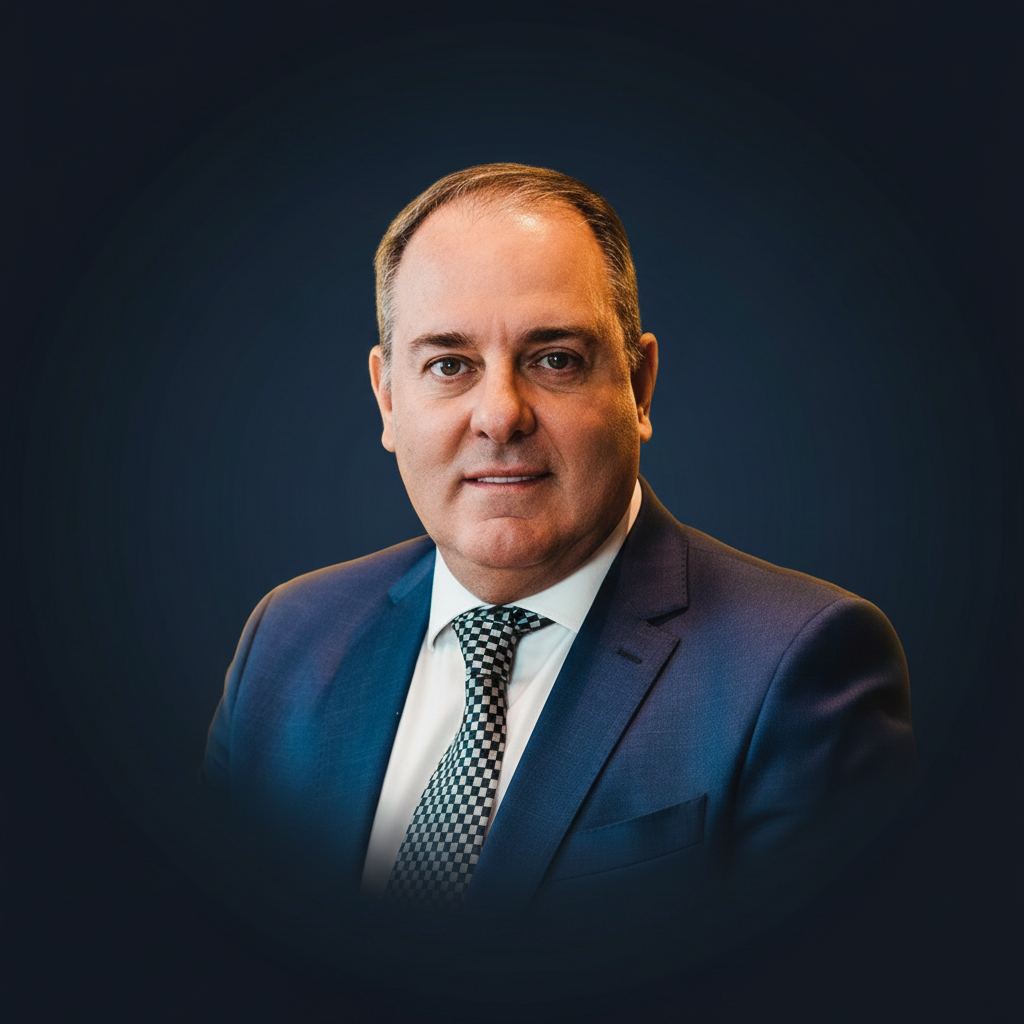
Roney Albert "Frajola"
Roney Albert
🇧🇷Brazil
Forty-four years in markets — and one of the last operators who actually shouted bids on the BM&F open-outcry floor.
Roney Albert was already on the floor of the BM&F (now B3) when Brazilian futures trading still happened by shouting. Forty-four years later he's the rare current-day public trader-educator whose teaching credibility comes from a career that pre-dates electronic execution. Two long-running projects sit on top of that history: Economy Class, and Oficina do Trader — pedagogy-first brands oriented toward currencies, derivatives, and the broader fixed-income / variable-income mix that Brazilian retail traders actually have to navigate.
The public surface today is YouTube and podcast-heavy: the YouTube channel under his own name plus the Os Donos do Dólar podcast give him a long-form medium for the kind of order-flow, scalping, and pit-floor mechanics that don't carry well in short clips. The own-voice line that titles one of the Trader Talks Cortes — "O mercado me ensinou o que eu sei", "the market taught me what I know" — is also the line that best captures the brand: practitioner, not theorist.
For Copa BTG Trader 2025 he was not on the leaderboard. He was inside the BTG editorial cycle as a Trader Talks guest — episode #2 in the long-form podcast and episode #105 during the October 2025 final cycle — and his role on the broadcast cycle was the commentator / mentor side, not the competitor pool. The page on this site reflects that explicitly: he's a Copa orbit figure, not a Copa finalist.
Interview
Você estava no pregão da BM&F quando a era viva-voz começou a acabar. Qual foi o momento exato em que você percebeu que o pregão eletrônico era inevitável — e o que te fez migrar antes dos outros?
The exact moment was when I realized the price started moving faster on the screen than in the open outcry, and the banks and brokerages began to reduce staff on the trading floor — many moving to internal positions and others being laid off.
In open outcry trading, a good operator had presence, hearing, body language reading, flow savvy and nerves of steel, and he knew what he was doing and had great memory. You'd look at the pit and you could tell who was really buying, who was really selling or short, who was bluffing and who was in desperation — especially those holding positions against the market.
But when electronic trading started gaining speed, it became clear that world wasn't going to ask permission before it ended, like what happened in several countries.
Those who thought electronic trading was just a fad died professionally clinging to nostalgia and didn't professionalize themselves or retrain or anything; they stopped studying, got stuck in time.
I migrated to electronic earlier but I was forced to, and also because I was never in love with that format. I was in love with the market. And the market doesn't care about nostalgia. So I migrated to electronic. The electronic market changes the platform, changes the screen, changes the code, changes the way execution works, but it keeps asking the same question: can you read price, risk and flow or do you just know how to repeat old habits?
A lot of people confused experience with immunity. Experience helps, but attachment kills.
I understood early on that the operator who didn't learn screen, technology, speed and electronic execution would become a museum piece. In my case, even being in the B3 Museum carries symbolic weight: I lived that history, but I didn't get trapped in it.
Você disse no Trader Talks: "O mercado me ensinou o que eu sei." O mercado é famoso por ser um professor caro. Qual foi a lição que você queria ter aprendido mais barato?
The most expensive lesson was understanding that being right isn't enough. That the market is geopolitical calculations, macro and micro economics.
That's the hit every trader takes a while to accept. You can be right on your thesis, right on the fundamentals, right on the macro reading, right on the final direction — and still lose money if you're wrong on size, timing, or leverage.
The market doesn't pay ego. The market pays execution.
I wish I'd learned cheaper that risk comes before opinion. A new trader thinks he needs to predict the market. Bullshit. First he needs to survive the market because the market is sovereign and doesn't forgive anyone who doesn't know what they're doing.
Because a good thesis with too big a position turns into tragedy. Conviction without a stop becomes stubbornness. And stubbornness in the market is just stupidity dressed up as courage.
The market taught me the hard way that the professional is the one who gets the headline right more often. It's the one who knows how much he can lose before he presses the button.
That difference separates a trader from a gambler. Like I say, the gambler and Mr. Vegas!!
I learned the financial market from the Old School crowd, the old foxes of the financial market, and then I went to learn derivatives in New York and Chicago back in the '80s.
Na Copa BTG 2025 você estava dentro do ciclo editorial como convidado do Trader Talks. O que você viu lá dentro que a cobertura pública não transmitiu?
Public coverage shows the spectacle: ranking, performance, competition, cuts, strong phrases and results. But what I saw on the inside was process. That's where it becomes clear who operates with method and who operates with adrenaline. From the outside, the public only sees the scoreboard. From the inside, you notice the brutal difference between the operator who has a plan, risk reading, repertoire and discipline — and the guy who's just trying to land a lucky punch out of desperation and the market won't tolerate mistakes. And there's something that public coverage can't really convey: the emotional aspect weighs just as much as the technical. Sometimes it weighs more. When you put an operator under exposure, competition, comparison and pressure, the truth comes out. The guy who looks like a genius looking at charts while sitting still often falls apart when there's money, ranking and the public watching. Live market strips the makeup off everybody. What struck me most was this: the new generation has tools we didn't have, but they still trip over the same old mistakes — overconfidence, leverage, lack of plan, lack of knowledge of the asset and economic calendar and childish need to prove they're right. The platform changed. The aesthetic changed. The speed changed. But vanity is still a trader-grinding machine. The worst part is that this new crew doesn't like to study, they want a miraculous setup and ready to get rich quick.
Quarenta e quatro anos de mercado. O que mudou mais — o mercado ou o trader brasileiro?
Both changed. But the market changed structurally; the Brazilian trader changed unevenly. And with way too much lack of raw knowledge.
The market became faster, more electronic, more global, more algorithmic and far less tolerant of amateurism. Before, information was scarce. Today, information is everywhere. The problem stopped being access and became filtering.
Back in the day, the operator fought to get data. Today he drowns in bad data, empty opinion, influencers selling miracles and social media traders confusing luck with competence.
The Brazilian trader improved in tools, but not necessarily improved in maturity.
There are more platforms, more charts, more indicators, more courses, more robots and more screens. But a lot of people still don't have the basics: risk management, reading context, sense of position size, discipline and humility before the market.
The difference is cruel: in the old trading floor, the market took your money right in front of everybody. Today it takes it silently, through the screen, and the guy still posts a motivational quote afterwards.
So the market changed more in technology. But the Brazilian trader still needs to change more in mindset and study to deeply know the assets and what makes them move and what economic agenda influences they suffer from.
Because after 44 years, the essence remains the same: the market doesn't forgive vanity, doesn't respect credentials and doesn't care about your opinion.
It only respects price, risk and survival.
There's a phrase I learned when I was on Wall Street: "the market wants those who don't know how to trade, because those who know already belong to it."