
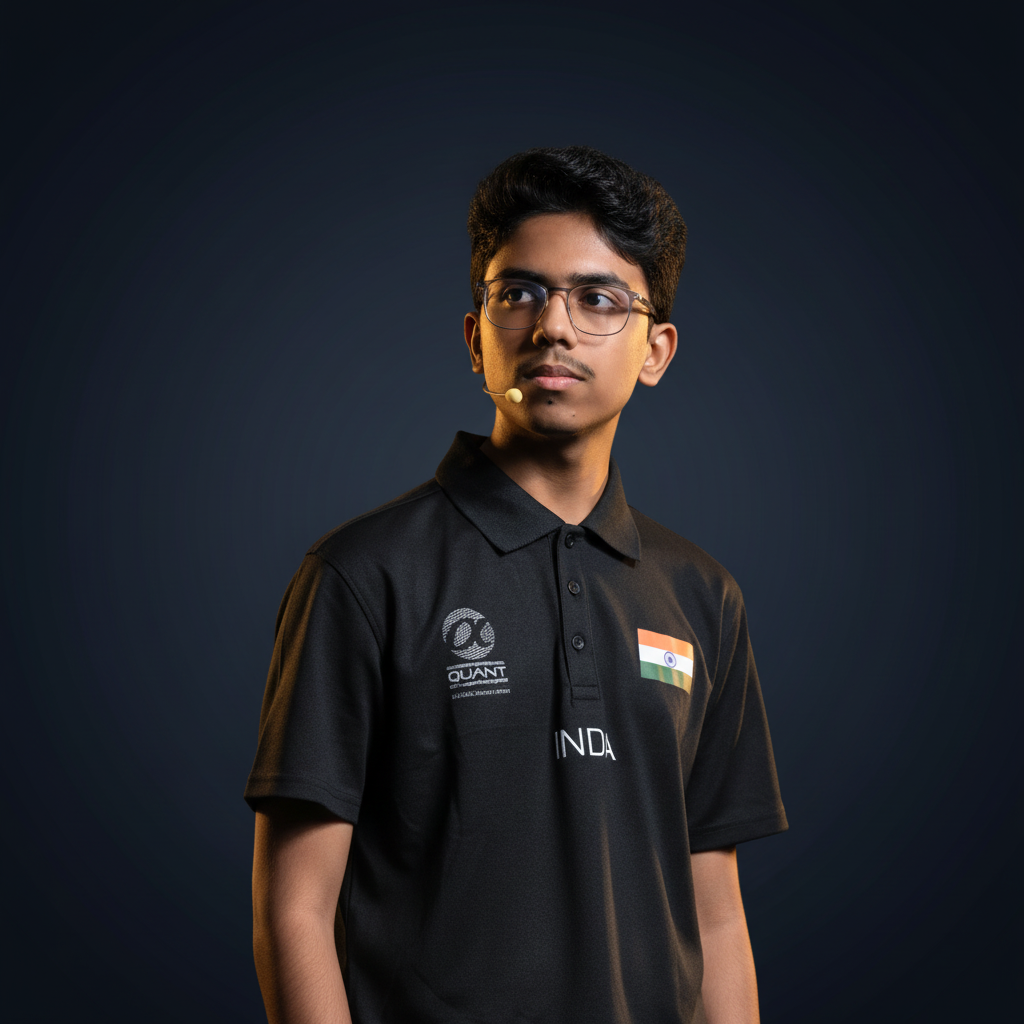
Sumit Kumar
🇮🇳India· Dhanbad
A second-year Engineering Physics undergrad who built his own LLM-driven alpha pipeline and rode it to silver in Singapore.
Sumit Kumar was a sophomore — second year of Engineering Physics at IIT (Indian School of Mines) Dhanbad — when he placed second at the 2025 International Quant Championship in Singapore, the only Indian on the podium. The 2025 edition was the first IQC run as individual competition, with twelve finalists representing the top 0.02% of nearly 80,000 contestants who submitted some 263,000 alphas to WorldQuant's BRAIN platform between March and August. IIT Delhi had won the 2023 IQC outright (Team Guava); Sumit's silver kept India on the IQC podium in a row of four straight editions where Indian universities have finished top-three.
What makes his entry technically interesting is what he built around the BRAIN platform itself. His GitHub repos include AlphaGen — a feedback-driven alpha generation pipeline that combines Google's Gemini API with the WorldQuant BRAIN API to auto-generate, backtest and iteratively refine trading signals — and AlphaTune, an automated hyperparameter-optimization framework for BRAIN alphas using Optuna. The shape of those tools tells you what his edge was: not a single clever alpha, but a system that produced many alphas fast and culled the bad ones automatically.
His public footprint is built on the work, not on persona — a LinkedIn page tagged quantsumitkumar, a GitHub as MiracleInvoker, a Google Scholar with early citations, and an IIT ISM Dhanbad Facebook post celebrating the win. No Twitter or YouTube presence located. He has not yet given a media interview that's been indexed in English-language coverage; the only sustained press piece is The Avenue Mail / The Jharkhand Story regional coverage.
Interview
How did you first hear about IQC, and when did you realize you were ready to compete seriously?
I first got to know about IQC when I saw a promotional message in one of my Institute's WhatsApp Groups. I was really interested in Quantitative Finance and decided to enroll then. The competition is divided into 3 stages and during the first stage I did not get much time. I seriously started competing from the second stage. I realized I was having a lot of fun while working on building Alphas so I decided to give it my all during stage 2.
Tell me about the final in Singapore. What was the hardest moment on the day of the competition?
The Global Finals were the most exciting opportunity of the whole competition. Just being there felt worth all the effort I had put in. It was also my first time going outside my country India. I met a lot of people including the other finalists and overall it was quite a diverse experience which I had never gotten before. The hardest part was the Surprise Problem Statement. I can't share too many details about the problem itself, but the biggest challenge was having to quickly understand a completely new situation and develop an effective solution within a limited time. It was difficult, but also a really fun and valuable learning experience.
How would you describe your approach to building alphas? More intuition-driven, or pure mathematics?
I come from an engineering background and had no prior knowledge of finance. My approach was more mathematics driven. For building Alphas I used techniques like template generation, combinatorial approaches and LLM-driven pipelines. I also used various statistical methods and custom key performance indicators to test the quantitative robustness of my Alphas.
You are a sophomore and just finished second in the world. How do your classmates and professors react to that?
The reaction has been very encouraging. My classmates and professors were proud and supportive, but I see it as one step in a longer journey. I am grateful for the people who have pushed me and helped me get there.
MinKyeom Kim won IQC 2025, you finished second. Do you know each other? How do you see your competitors from other countries?
We met during the global finals, although we didn't know each other before that. I have a lot of respect for him, winning at this level is a huge achievement. Honestly, one of the best parts of international competitions is meeting people from different countries who share the same passion. Everyone pushes each other to get better.
What is next for you: WorldQuant, academic research, your own quant fund?
I plan to continue pursuing research while also staying involved with WorldQuant BRAIN Platform as a Research Consultant after my internship. A quant fund is definitely an exciting possibility in the long term, but for now I believe I still have a lot to learn and explore. My priority is to keep growing and building a stronger foundation.
If you could change one moment from the final, what would it be?
Honestly, I do not think I would change any particular moment. There were definitely things I could have done better, but every decision was part of the learning experience. I am grateful for how the finals went, and I will use what I learned to improve for the future.