
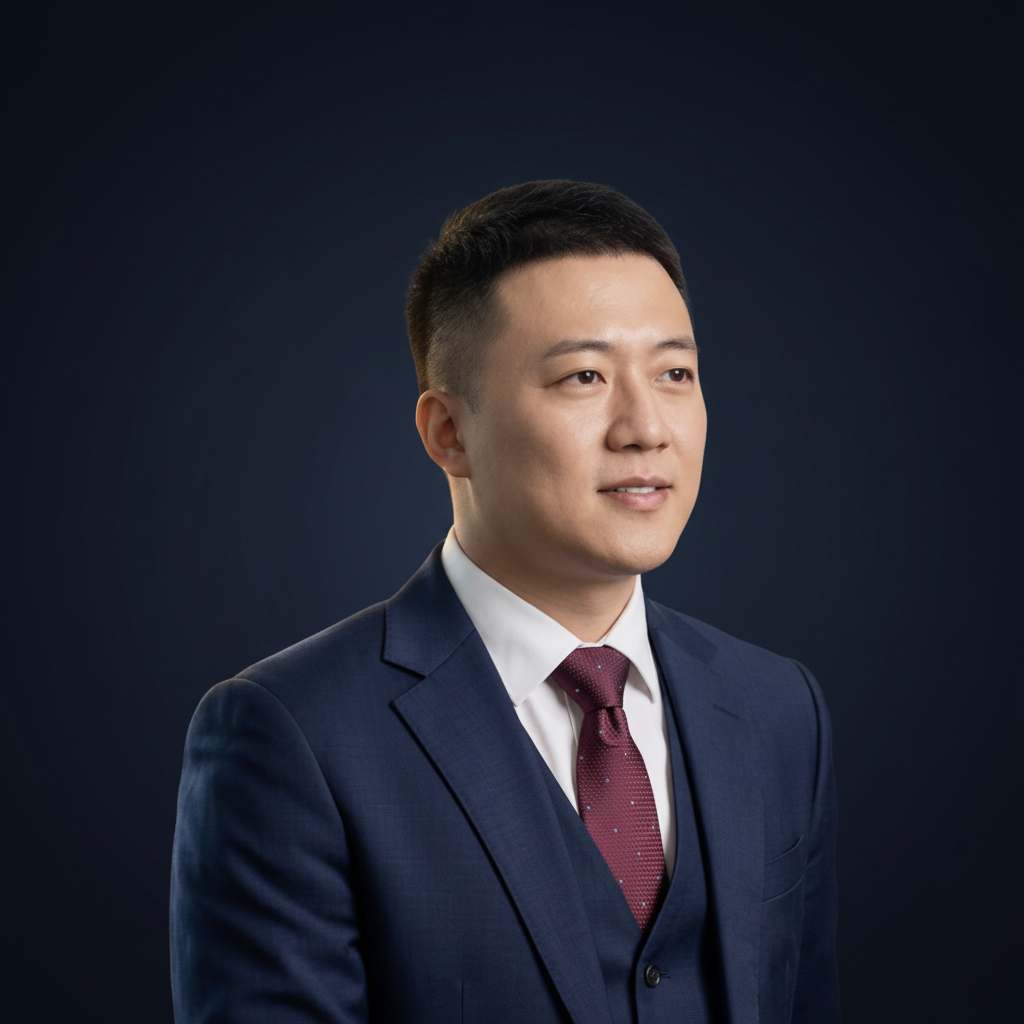
Chia-Chun Chung
🇹🇼Taiwan· Hsinchu
"Understanding why an alpha works is far more valuable than finding one that works by accident."
Chia-Chun Chung comes from Hsinchu, the Taiwanese city at the heart of the island's semiconductor industry. He is a Senior AI Researcher in the automotive sector, a part-time PhD student in Computer Science at National Taiwan University, and a Computer Science graduate of National Yang Ming Chiao Tung University (NYCU). In 2025 he took bronze at the WorldQuant International Quant Championship, standing on the podium at Marina Bay in Singapore as one of twelve global finalists drawn from the top 0.02% of nearly 80,000 contestants who submitted some 263,000 alphas. He placed second in Stage 1 and first in Stage 2 on the way there.
His route into quant was unusual. An AI and reinforcement-learning researcher by day, he grew curious about how machine learning could be applied to markets, discovered WorldQuant's BRAIN platform through friends in quantitative finance, and found alpha-building "surprisingly addictive," treating each alpha as a small research project built on a hypothesis and refined with data. He manages his own portfolio through quantamental research, combining fundamental analysis with quantitative methods, trades with proprietary firms, and is now a WorldQuant Consultant.
Beyond the leaderboard, his deepest passion remains artificial intelligence: reinforcement learning, large language models, and building AI systems that help researchers generate new hypotheses and accelerate discovery. He has a knack for finding signal in unexpected places, once turning an observation about how traffic congestion builds and clears into hypotheses about how information propagates through markets and supply chains in waves. Away from the screen, music and reading are where many of his best ideas arrive.
Interview
How did you first discover WorldQuant and the BRAIN platform? Who or what led you there?
I first heard about WorldQuant through friends who were interested in quantitative finance. At that time, I was mainly working on AI research and reinforcement learning, but I became curious about how machine learning and data-driven research could be applied to financial markets. That curiosity led me to explore the BRAIN platform, and once I started building alphas, I found it surprisingly addictive. Every alpha is like a small research project: you form a hypothesis, test it with data, and continuously improve it.
NYCU was formed by merging two universities in 2021, a unique environment. How important was networking in your journey, and did the people around you influence your success at IQC?
Networking played a huge role in my journey. One of NYCU's greatest strengths is its diverse community. I had the chance to meet people from different backgrounds, including AI, computer science, finance, medical, and electrical engineering, and everyone brought a unique perspective to solving problems. For IQC, discussing ideas with friends was incredibly valuable. Many of my best ideas and improvements came from conversations rather than working alone. Sometimes a simple discussion can completely change how you think about an alpha. Having people who challenge your assumptions is one of the fastest ways to learn and grow.
When you wrote your very first alpha on BRAIN, what was it, what did it look like, and did it actually work?
My first alpha was actually very simple. I experimented with basic price and volume factors, trying to understand how the platform worked instead of chasing performance. It definitely wasn't a great alpha, and I don't even think it passed all the submission criteria. But it taught me the most important lesson: understanding why an alpha works is much more valuable than finding one that works by accident. Instead of giving up on that idea, I kept refining it. I expanded the original hypothesis, experimented with different variations, and gradually improved its performance until it became a much more robust alpha. That experience also taught me that building a good alpha is usually an iterative process rather than a one-time success.
How did you find out you made the finals? What did you feel in that moment?
Although I finished second in Stage 1 and first in Stage 2, I still wasn't completely sure I would make the finals. So when I received the notification from WorldQuant, I honestly had to read it twice to make sure I wasn't misunderstanding it. The first feeling wasn't excitement, it was disbelief. After that came excitement, but also a strong sense of responsibility. Making the finals meant representing not only myself, but also my university and Taiwan on the global stage.
The IQC 2025 final was in Singapore. Had you been there before? What was it like to stand on the podium at Marina Bay?
It was actually my first time visiting Singapore. Standing on the podium at Marina Bay was unforgettable. Looking back over the months of research, debugging, failed ideas, and late nights, it felt like all the effort had finally paid off. More importantly, I felt proud that our team could represent Taiwan and NYCU on the global stage.
You finished third, meaning you watched someone take first and second. What were you thinking about your competitors when you saw the results?
My first thought was respect. In a competition like IQC, everyone on the podium has spent countless hours researching and testing ideas. Rather than thinking about losing first place, I was curious about what they had done differently and what I could learn from them. In fact, it wasn't just the first- and second-place teams that impressed me, everyone in the finals was incredibly talented and creative. I was genuinely surprised by the diversity of ideas. For example, the UK team incorporated equations from aerodynamics and some physics into their alpha hypothesis and presented them in a really engaging way. It was fascinating to see how concepts from completely different fields could inspire quantitative research. Competitions are temporary, but learning from outstanding competitors lasts much longer.
How do you find ideas for alphas, is it math, intuition, data, news? Where do the ideas actually come from?
Ideas can come from almost anywhere. Sometimes they come from academic papers, sometimes from financial news, and sometimes simply from asking "why" when I notice something unusual in the market. For beginners, I also think the WorldQuant BRAIN platform offers a lot of valuable learning materials and examples that provide a great starting point. Personally, I like to start with an economic intuition or a hypothesis, then use data to test whether it actually holds. In my experience, combining domain knowledge with systematic experimentation is much more effective than blindly searching for signals.
Do you work at night or on a schedule? Any rituals before you dive deep into work?
I usually work on a schedule because, during the competition, I was working full-time as an AI researcher in the automotive industry. That meant I only had limited time each day to work on IQC. Of course, before important deadlines, I sometimes stayed up late to finish experiments or validate new ideas. One habit I've developed is writing down exactly what I want to verify before starting an experiment, along with the expected outcome of the hypothesis. It sounds simple, but having a clear research question and a defined expectation prevents me from spending hours running experiments without learning anything meaningful.
What's the attitude toward quant trading in Taiwan, is it already popular, or are you one of the few?
Thanks to the rapid growth of AI and the strong performance of the stock market in recent years, investing has become increasingly popular in Taiwan. Quantitative trading is also gaining attention, but compared with places like the US or Singapore, it is still relatively niche. That said, more students, researchers, and engineers are becoming interested in the field, especially as AI and data science continue to develop. I believe we're only at the beginning of a much larger trend, and Taiwan has great potential to cultivate more talent in quantitative research.
Do your parents understand what you do? How did they react to third place in the world?
I don't think they fully understand quantitative trading, and honestly, that's completely normal. But they understand hard work. When they heard we finished third in the world, they were extremely proud, even if explaining what an alpha is still takes some effort.
After IQC, did you receive any offers, from WorldQuant or other companies?
The competition definitely opened new opportunities for me. It allowed me to connect with people from both academia and industry, and I was honored to become a WorldQuant Consultant. I didn't receive any full-time job interview offers from WorldQuant afterward, but that wasn't my primary goal in joining IQC. For me, the most valuable outcome was the experience, the people I met, and the opportunity to grow as a researcher.
If you could redo your preparation for IQC 2025, what would you change?
I would start reviewing my previous submissions much earlier. Many good ideas don't fail because they're wrong, they fail because they're incomplete. Looking back with more experience, I found that several old alphas could have been significantly improved instead of being abandoned too early.
What's next, defending a podium spot at IQC 2026, or are you already thinking bigger?
Of course, I'd love to perform well again, but my goals have grown beyond competition results. We're entering an era of AI-driven discovery, and I believe the potential of AI is enormous. Rather than simply using AI to automate existing workflows, I'm interested in building AI systems that can help researchers think more creatively, generate new hypotheses, and accelerate scientific discovery. That's why I want to continue exploring the intersection of AI and quantitative research, developing systems that can help researchers discover better ideas more efficiently.
What's the strangest source of an alpha idea you've ever had, something from everyday life that turned into a hypothesis?
One interesting source is actually traffic. Watching how traffic congestion builds and clears made me think about how information propagates through financial markets. Not every investor reacts immediately, and market reactions often happen in waves rather than all at once. That observation inspired several hypotheses related to delayed market reactions. Taking that idea one step further, I started wondering whether a similar "wave" effect could exist along an industry supply chain. For example, if downstream companies begin raising prices or reporting stronger earnings, could upstream suppliers benefit later as demand and orders gradually flow through the supply chain? If so, the market might not price in that information immediately, creating potential alpha opportunities. Whether the hypothesis is correct is something that data has to answer, but I find it fascinating that an everyday observation like traffic can spark a completely different way of thinking about financial markets.
Have you ever lost a competition that genuinely upset you? What was it?
Definitely. As a researcher, failed experiments happen far more often than successful ones. I've experienced competitions and research projects where months of work didn't produce the outcome I wanted. At the time, it was frustrating. Looking back, though, those failures taught me much more than my victories, because they forced me to rethink my assumptions and improve my methods.
If you take away everything finance-related, what truly interests you outside of trading?
Artificial intelligence is still my biggest passion. I enjoy building AI systems, especially reinforcement learning and large language model applications. Beyond research, I also enjoy listening to music and reading. Those activities help me clear my mind, and interestingly, many of my best ideas come when I'm away from my computer rather than sitting in front of it.