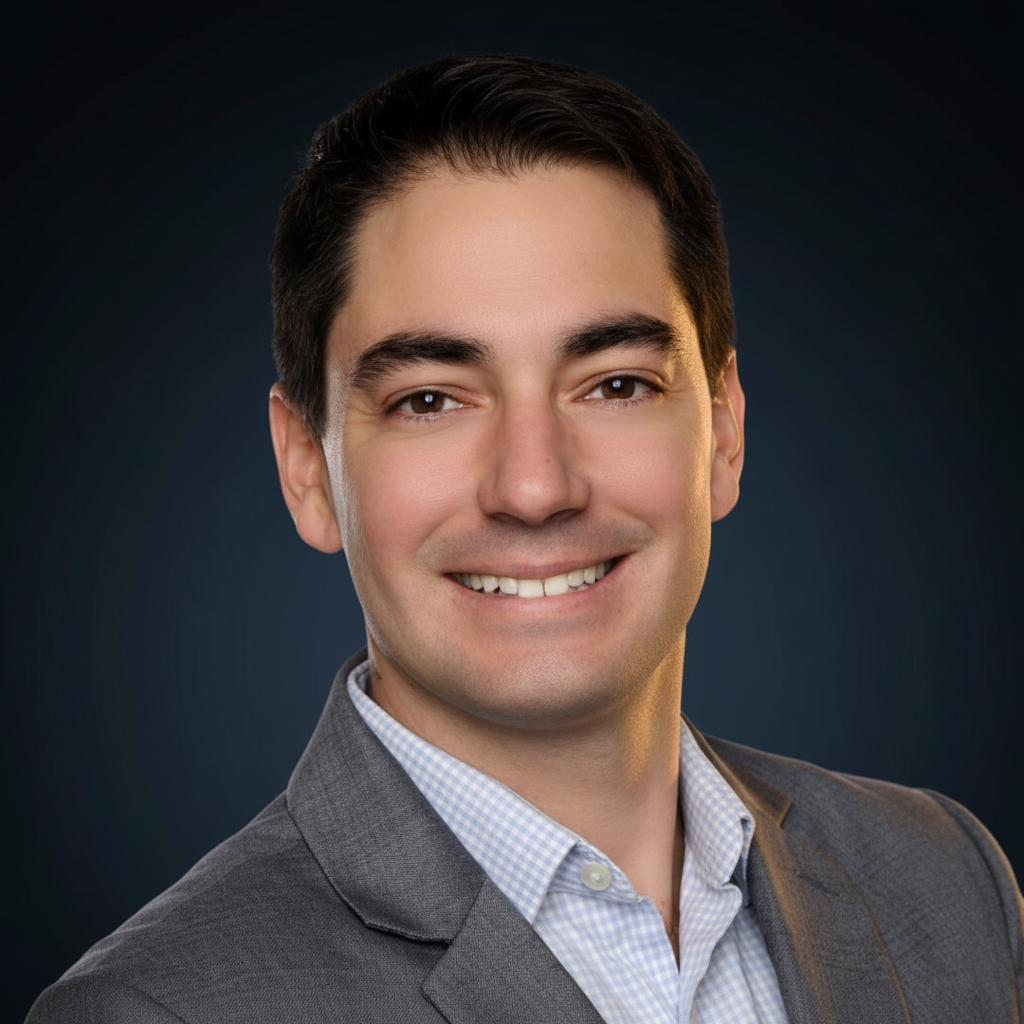
Gabriel Blanco
Gabriel Blanco, CPA
🇺🇸United States· Miami, FL
Ukrainian-Cuban-American Miami CPA who has been on the USIC leaderboard four years running — and runs a tax practice when the markets close.
Gabriel Blanco is a Miami-based CPA and sole proprietor of Real Accounting Solution. By day he helps businesses manage taxes, compliance, and financial controls. When the markets open, he competes in the US Investing Championship — and has appeared on its top leaderboard four years running: +108.3% in 2023, +218.7% in 2024, +239% in 2025, and +135.7% in Q1 2026.
Born in Ukraine and raised in Cuba, Blanco came to the United States with a mindset shaped by scarcity. His career in accounting — built at KPMG US, Carnival Cruise, 3Sixty Duty Free, and Vizcaino Zomerfeld LLP before founding his own practice — gave him a structural understanding of risk that most traders develop the hard way. His approach is discretionary swing equity selection in the USIC $20K-$1M Stock/ETF Division.
What makes his record unusual is its consistency. Most championship top finishers post a single breakout year before reverting to the mean. Blanco has held the line four consecutive times on a real-money audited account with a single methodology. Off the markets, he plays tennis and dances salsa.
Interview
Ukraine, Cuba, Miami, three countries, three very different economies. Which one shaped your relationship with money the most?
Definitely Cuba, and mostly in a negative way. Growing up in a place where almost everything is scarce creates a scarcity mentality. You learn to focus on not losing what you have instead of creating more opportunities. In my family, losing money was treated as a disaster, so taking any financial risk was often viewed as irresponsible.
As a CPA you spend your days managing other people's finances. How does that change the way you handle your own?
It actually created an interesting contradiction in my life. As a CPA, I spend my days helping people protect money. Budgets, controls, taxes, compliance, reducing risk. The job is largely about defense.
But when I looked at the people who became truly wealthy, very few did it by focusing only on defense. They built businesses, invested, took calculated risks, and looked for opportunities. So on personal finances, I tend to focus much more on offense.
Was there a moment when you almost quit trading? What kept you going?
Trading did not come naturally to me at all. I had many tough moments where I seriously considered quitting.
But at beginning, my biggest problem was timing. I would get excited after hearing stories about huge market rallies and traders making life-changing money. By the time I finally jumped in, the rally was often already near its peak. I would buy near the top, take painful losses, and convince myself that maybe trading wasn't for me.
Then a few months later, I'd see the market do it all over again. New stocks, new opportunities, new traders making money. That's when something clicked. I realized trading wasn't about catching one rally. It was about surviving long enough to participate in many of them.
Salsa and tennis both require coordination and reading the moment. Have you ever noticed a connection between those and how you trade?
The market has its own rhythm. Traders call them themes, cycles, trends, and momentum, but it's really the same idea. Some years it's AI, some years it's energy, some years it's small caps. The music changes, and the successful traders are the ones who recognize it early and adapt.
You grew up in Cuba. When did you first truly understand what a market was?
I read my first investment book at 19. Growing up in Cuba, I didn't really understand markets because there weren't capital markets or a culture of investing. When for the first time I realized there was actually a profession where you could study businesses, allocate capital, and build wealth through investing — I was hooked and obsessed.
If you could give one piece of advice to your younger self, not about trading, but about life, what would it be?
Don't confuse being safe with making progress. Some of the biggest risks I took improved my life, and some of the safest decisions kept me stuck.
Do your accounting clients know you're a trading champion?
Most of them don't. I don't make a lot of noise about my trading, and that's intentional.
One thing trading teaches you is humility. I've gone through plenty of ups and downs over the years, and I've learned that celebrating too much is often an invitation for the market to humble you.
So I try to stay grounded. My accounting clients hire me to solve accounting problems, not to hear about my trading results. If they happen to find out, that's fine, but I've always believed it's better to focus on the process than the recognition.
You built your own process without following other traders. What did influence you then — from outside trading, from life?
Early in my career, I definitely learned from other traders. I followed traders like Michael Koenig from Trade On The Fly, and I read books like The Intelligent Investor and other Warren Buffett-related material.
But as I developed, I gradually moved toward isolation. I found that other people's opinions were often giving me the wrong bias. I'd have a good setup, hear a convincing argument from someone else, and start second-guessing myself.
Ironically, the biggest influence on my trading was learning to think independently. The market doesn't pay you for having the same opinion as everyone else. It pays you for being right. At some point, I realized I needed to trust my own process more than anyone else's.
Do you see trading tournaments evolving into more public, offline events, like live competitions with an audience?
Yes, I do. In many ways, we're already seeing early versions of it. People like Roaring Kitty built massive audiences around their trades, and investors like Cathie Wood gained popularity by publicly sharing portfolio changes and investment decisions. The public clearly has an appetite for watching investment decisions unfold in real time.
Would you personally want to compete in a live, in-person trading tournament?
Absolutely. I'd love to become more involved in trading-related activities beyond just trading my own account.
The reality is that most traders either offer a service, manage outside capital, create content, or have a traditional job like I do. Trading income can be inconsistent, and when you're self-funded, it's difficult to justify stepping away from a profitable business to attend tournaments and events.
That's one reason I still maintain my CPA practice. It provides stable cash flow and allows me to trade without the pressure of needing to make money every month. As trading becomes more mainstream and opportunities around tournaments continue to grow, I could definitely see myself participating more. I think we're still in the early stages of what trading competitions can become.