
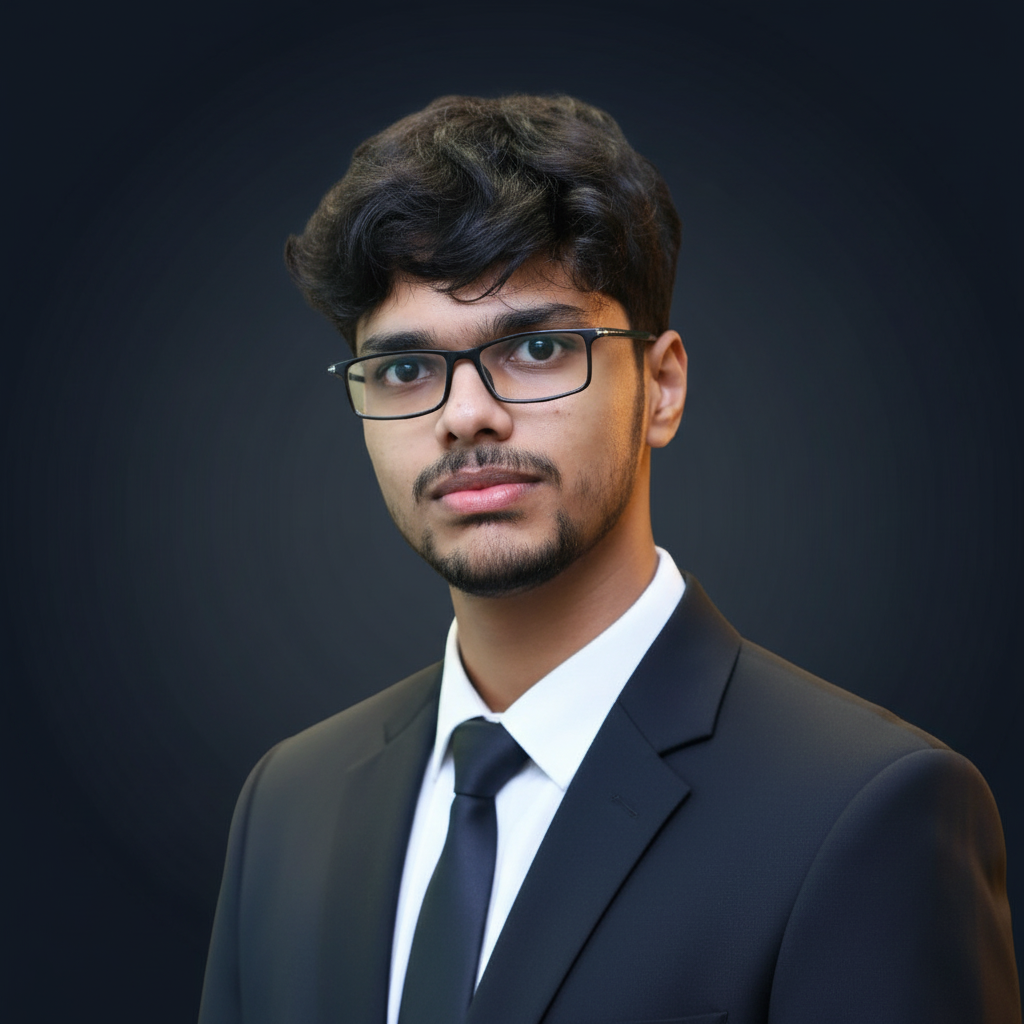
Ravi CharanVerified
IQC 2026 India National Finals winner, IQC Global Finalist
🇮🇳India· Hyderabad
When you're competing to win, you're pushed to learn as much as you can, as efficiently as possible.
Ravi Charan is a third-year student at the Indian Institute of Technology Madras, studying Naval Architecture and Ocean Engineering, and a Research Consultant at WorldQuant since May 2026. His path into quantitative finance began with a trading simulation run by IMC on his campus, and he has been building his skills in quant research, applied mathematics, competitive programming and machine learning ever since.
In the International Quant Championship 2026, Ravi and his teammates Siddhesh Kamble, Tisha Hirani and Prathamesh Dharmaraja, competing as Team Smoooth Operator, won the India National Finals and went on to represent India at the IQC Global Finals. According to Ravi, the team also placed 39th in India at IMC Prosperity.
Ravi describes IQC as a six-month grind where consistency decides everything: a first stage of learning, a second of testing and refining their own ideas, and a final stage where the team pushed for its strongest results. He plans to keep competing, seeing every contest as the fastest way to learn.
Interview
Tell us a bit about yourself, how did you get into quantitative research and trading?
I'm a third-year student at IIT Madras. My journey into quant began when I attended a trading simulation conducted by IMC on our campus. That experience sparked my curiosity, and I've been learning ever since. Since then, I've taken part in competitions like IQC, where our team ranked first in India, and IMC Prosperity, where we placed 39th in India. Both were incredibly rewarding experiences, and I'm excited to keep exploring this field further.
Naval Architecture and quant trading seem like worlds apart, what's the unexpected overlap you've found between designing ships and designing trading signals?
On the surface they're completely different, but at their core, both are about problem-solving and optimization. In quant trading, you're looking for inefficiencies in the market and optimizing a strategy without overfitting it to past data. In ship design, you're deciding on a vessel's dimensions while accounting for everything that could go wrong, like storms and big waves. That mindset of planning for the worst-case scenario is exactly how you think about risk in the markets. A ship has to survive rough seas, and a strategy has to survive rough markets.
Did you and the team have any strange habit or ritual during the competition that would look weird from the outside?
Honestly, we didn't have any special rituals. Most of our time went into worrying about out-of-sample performance. The rest went into hyping each other up, joking that we'd all be landing internships soon. It kept the stress manageable and the morale high.
What's a completely wrong assumption you had about quant trading before you actually got into it?
I assumed quant trading was a very gated field, one where you needed a huge background and a deep understanding of everything before you could even get started. Once I got into it, I realized that everyone starts somewhere. I started from scratch too, and the most important thing is simply taking that first step and learning along the way.
What's the weirdest data source or unconventional idea you've ever tried to build a signal from?
One unconventional idea we explored was building a signal around the wave of scams that surfaced during the COVID era. After Bitcoin took off, a flood of cryptocurrencies appeared promising insane returns, and many of them turned out to be scams. We tried to see whether that kind of hype and fraudulent activity could be captured as a signal. It was an interesting way to think about how market sentiment and speculation leave traces in the data.
What do you think people on the outside get completely wrong about the world of quant finance?
A lot of people see quant as something reserved for an elite few, so they never even get started. There's a common belief that you need to be an exceptional math or computer science prodigy to break into the field. In reality, curiosity, consistency, and a willingness to learn matter just as much. The field is far more accessible than it looks from the outside.
What does the actual process of competing in IQC look like from the inside, day to day through the different stages?
Competing in IQC was a huge grind, especially during the final stages. Since the competition runs for close to six months, consistency is everything. If you slip up even once, someone is ready to take your place, and just like in the real world, getting complacent is never an option.
Stage 1 was all about learning. We focused on building our understanding and preparing for the journey ahead. Stage 2 is where we started testing our own ideas, building on them, and refining them. Stage 3 was the culmination of everything we had learned, where we pushed ourselves to do some really impressive work and ended up producing some outstanding results.
How do you see the future of competitions like IQC, growing, evolving, pulling in more people?
I believe competitions like IQC will keep growing and attracting more participants. As interest in quant finance becomes more widespread, more people will be eager to prove themselves and showcase their talent and hard work. Competitions like IQC give them the perfect platform to do exactly that.
Are you planning to compete in future IQC editions or similar competitions down the line?
Absolutely. I don't plan on stopping anytime soon, because I believe competitions are one of the best ways to learn. When you're competing to win, you're pushed to learn as much as you can, as efficiently as possible, and to apply it to the best of your ability. That kind of growth is hard to find anywhere else.
Do you see yourself exploring other quant competitions (Kaggle, Jane Street, that kind of thing), or is IQC your main track for now?
Yes, I definitely plan to explore more competitions. Each one brings its own challenges and a different way of approaching problems, so I see them all as opportunities to learn something new and keep growing in this field.