
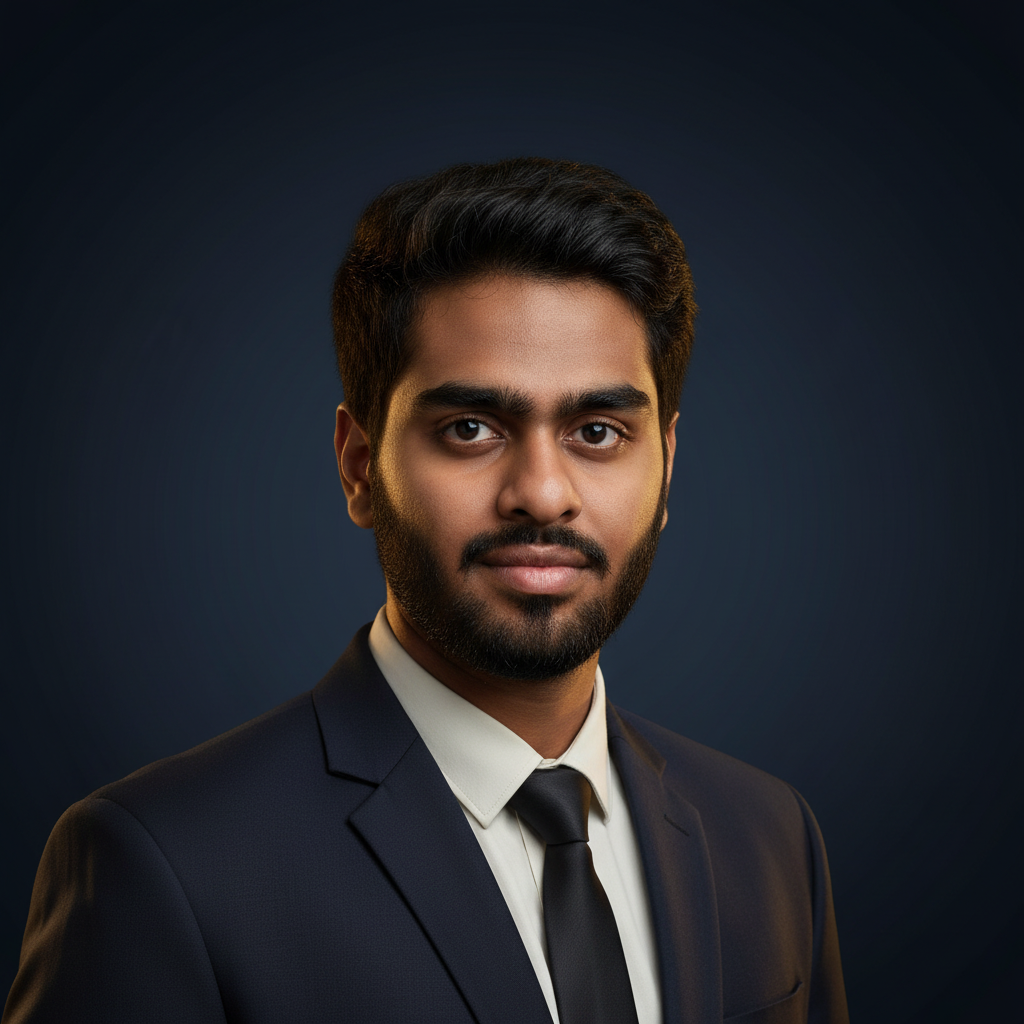
Prathamesh DharmarajaVerified
IQC 2026 India National Finals winner, IQC Global Finalist
🇮🇳India· Mumbai
Start before you feel ready. Competitions themselves are the fastest way to learn.
Prathamesh Dharmaraja is a student at the Indian Institute of Technology Madras, pursuing a BTech in Naval Architecture and Ocean Engineering, and a Research Consultant at WorldQuant since May 2026. His interest in quantitative research grew out of a fascination with applying mathematical and statistical thinking to messy, real-world problems like markets. His first serious exposure to the field came through IMC Prosperity, where, according to Prathamesh, his team finished 39th nationally.
In the International Quant Championship 2026, Prathamesh and his teammates Ravi Charan, Tisha Hirani and Siddhesh Kamble, competing as Team Smoooth Operator, went through two preliminary rounds and won the India National Finals. Before the final presentation, the team ranked in the top 3 nationally on out-of-sample performance but sat 8th on the overall leaderboard, and had to win the judges over by defending their approach like researchers, not just presenting numbers. Read Ravi's interview here.
The team will represent India at the IQC Global Finals on October 6 and 7. Prathamesh names Jim Simons as his main inspiration and believes the most underrated skill in quant trading is intellectual honesty: the discipline to kill your own idea when the data tells you to.
Interview
Tell us a bit about yourself, how did you get into quantitative research and trading?
I am currently a student pursuing Naval Architecture and Ocean Engineering at IIT Madras, and my interest in quantitative research grew out of a fascination with how mathematical and statistical thinking can be applied to messy, real-world problems like markets. My first serious exposure to the field was through IMC Prosperity, a trading simulation competition, where my team finished 39th nationally. That experience was truly enriching, and that's what convinced me to pursue the field of Quantitative Finance.
What pushed you and your team to take part in IQC 2026?
We initially learned about this competition through a programme on campus and found it interesting, so we decided to take part in it.
How many stages did you go through before winning the India National Finals?
We went through two preliminary rounds before reaching the National Finals. Winning the Finals after that progression made the result feel earned rather than incidental, every round raised the difficulty and narrowed the field.
What was the toughest moment on the way to winning the National Finals?
The toughest moment came right before the Finals presentation. Despite ranking in the top 3 nationally on out-of-sample performance, we found ourselves sitting 8th on the leaderboard for the overall score, a gap that didn't reflect the strength of our underlying strategy, but still put real pressure on us heading into the final round.
That gap changed how we approached everything from that point on. Every remaining decision, how we structured our presentation, which results we chose to highlight, how we explained our reasoning to the judges, had to be deliberate. We couldn't just present numbers; we had to make a case for why our approach was robust despite where we stood on the board. It pushed us to think less like competitors chasing a rank and more like researchers defending a thesis, which in hindsight was exactly the shift that helped us stand out.
What changed in your understanding of quant research after this experience?
Going in, I think I saw quant research mostly as a modeling problem: build the right model, get the right edge. What this experience reinforced is that a strategy's edge is only half the story; the other half is discipline around the less glamorous parts of the process: robustness checks, position sizing, drawdown management, and knowing when to trust or override a model.
It's easy to be drawn to the modeling itself, but things like testing parameter sensitivity or deliberately stress-testing a strategy against the worst-case conditions it might face are often what actually determine whether it holds up outside a backtest. I came out of this experience with a much deeper respect for that discipline, because it's usually what separates a good strategy from one that actually survives.
How are you preparing for the Global Finals?
We're treating this stage with the same rigor we applied to the Nationals, but scaled up. That means reviewing what worked and what didn't in our National Finals strategies. We are trying different approaches that would set us apart from our competitors. Our goal is once again a good out-of-sample performance, but along with a strong leaderboard finish this time around.
Who or what inspires you in this field, mentors, books, specific researchers?
I don't have one specific mentor I can point to, but I've drawn a lot of inspiration from the pioneers of quantitative finance, particularly Jim Simons. Something he said has stuck with me: "We don't start with models. We start with data." It's a simple idea, but it reframes how I approach problems, resisting the urge to force a hypothesis onto the market and instead letting the data reveal what's actually there. That mindset, of staying skeptical of your own assumptions and following evidence rather than intuition, is something I try to carry into every project.
What do you think is the most underrated skill in quant trading?
I'd say it's intellectual honesty, specifically, the discipline to kill your own idea when the data tells you to. It's natural to get attached to a model you've spent hours building, and the instinct is often to look for reasons it should work rather than evidence that it doesn't.
The skill that actually matters is being able to step back from your own strategy, question your assumptions as rigorously as you would someone else's, and let go of an idea the moment the evidence stops supporting it. That kind of self-skepticism doesn't get talked about as much as technical ability, but it's often what separates a strategy that looks good in a backtest from one that actually holds up.
Do you see yourself in the future at a hedge fund/quant firm, or more in academia?
Right now, I'm drawn more toward the industry side. I like the feedback loop of testing an idea and seeing it play out against real markets, which is harder to replicate in a purely academic setting. That said, I still have a lot to learn, and I'm keeping an open mind. What this journey has confirmed is that I want quantitative research to be a core part of whatever I do next, whether that's at a fund or in a more research-driven role.
If you could give yourself one piece of advice before starting this journey, what would it be?
Start before you feel ready. When I began with IMC Prosperity, I didn't feel like I had the technical background to compete seriously, but the only way to build that background was to jump in and learn from getting things wrong. If I could tell myself one thing at the start, it would be that competitions themselves are the fastest way to learn. Don't wait until you feel qualified to start.